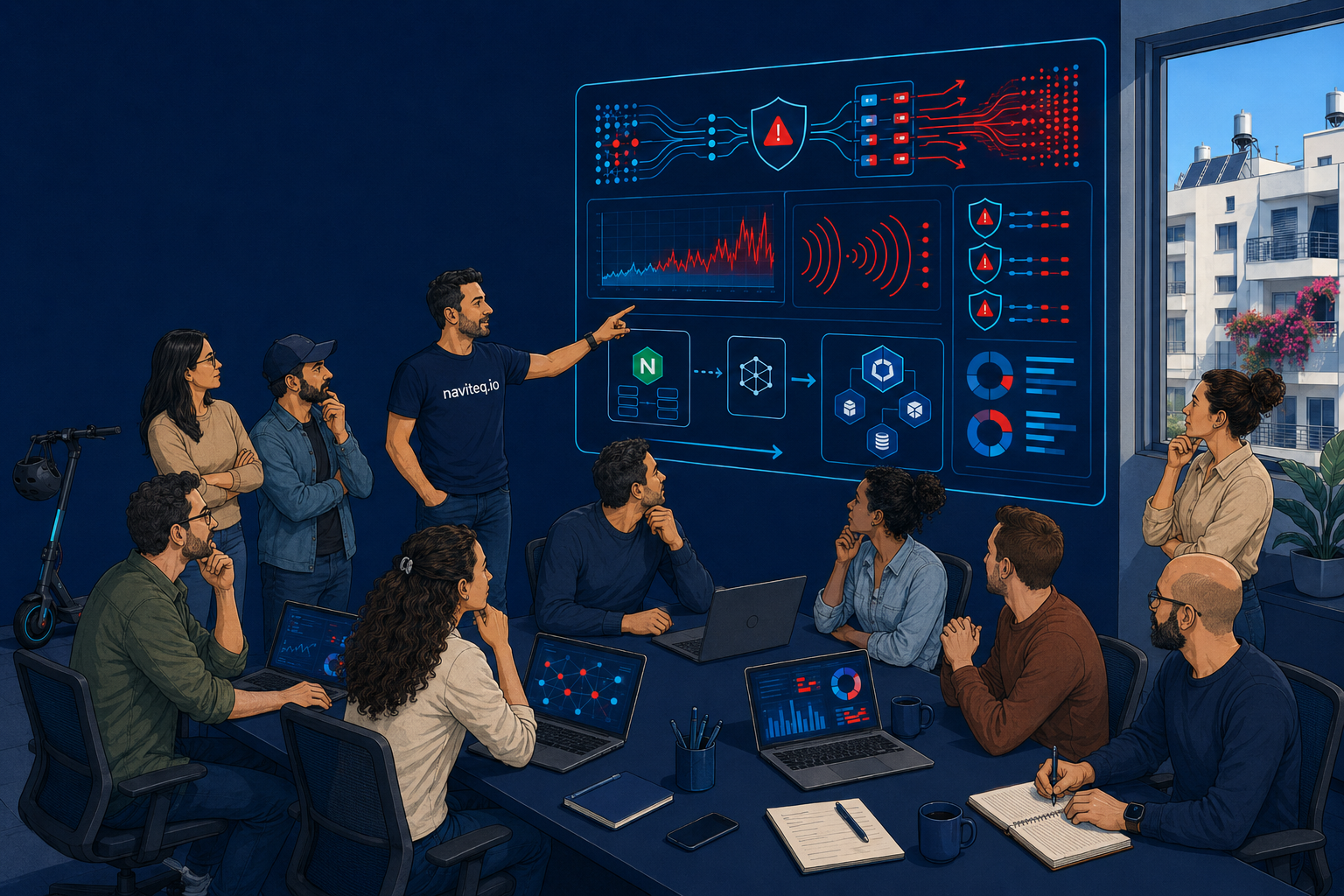


It’s 2am. A P1 alert fires. Your on-call engineer pulls up CloudWatch, sees elevated latency on an AWS Lambda function, then pivots to Azure Monitor to check the downstream API it’s calling, only to find the alerting thresholds are configured differently, the trace context is gone, and there’s no unified view of what’s actually broken. Forty minutes later, the root cause turns out to be a misconfigured network policy that got applied post-deployment on the Azure side.
Multi-cloud DevOps is the practice of designing, deploying, and operating software systems across two or more cloud providers such as AWS, Azure, GCP, or OCI using shared pipelines, governance frameworks, and observability tooling. Done well, it gives organisations resilience, flexibility, and negotiating leverage. Done poorly, it multiplies operational risk at every layer of the stack.
This blog post covers the four areas where that complexity hits hardest i.e CI/CD fragmentation, infrastructure drift, observability gaps, and the governance challenge that ties all three together.
The Multi-cloud reality in 2026
Before diagnosing the problems, it helps to understand the scale. These aren’t edge cases, they’re industry norms.
- Over 75% of mid-size and large organisations now run multi-cloud or hybrid strategies
- Only 3 in 10 can accurately track their cloud spend across providers
- 80% of software organisations will rely on internal developer platforms by end of 2026
- Multi-cloud environments generate 3 to 5 times more operational alerts than single-cloud setups
If your team feels like they’re constantly firefighting without making structural progress, that’s not a people problem. That’s a multi-cloud complexity problem. Knowing that helps you solve the right thing.
Multi-cloud CI/CD challenges
Every major cloud provider ships its own native CI/CD tooling. AWS has CodePipeline, Azure has Pipelines, GCP has Cloud Build. When a team runs all three, deployment pipelines diverge fast. A pattern that works cleanly on AWS frequently requires a completely different implementation on Azure. The cognitive overhead alone is enough to kill velocity.
Here’s what that actually looks like in practice:
- Pipeline fragmentation: there’s no single source of truth for deployment status across clouds. Developers have to check multiple consoles to know whether a release landed everywhere or just in one environment
- Authentication complexity: each cloud has its own IAM model. Service accounts, roles, federated identities, and secrets multiply across environments, and managing them consistently without a policy-as-code approach is a maintenance trap
- Inconsistent rollback behaviour: rollback strategies aren’t portable. What triggers an automatic rollback in one cloud may not even exist as a concept in another
- Toolchain sprawl: teams end up maintaining multiple pipeline definitions for the same application, which means bugs get fixed in one pipeline and forgotten in the others
The tools that solve this are worth naming directly. Argo CD handles GitOps-based multi-cluster synchronisation from a single control plane. Tekton gives you a vendor-neutral pipeline framework that runs on any Kubernetes cluster. GitHub Actions with cloud-specific runners can span providers when set up correctly. Harness adds AI-driven insights on top of multi-cloud pipelines.
The 2026 direction for multi-cloud CI/CD is GitOps extended to multi-cluster and multi-cloud environments, one control plane, one desired state, regardless of which provider sits underneath. Teams adopting this model are seeing meaningfully faster deployments and far fewer drift-related incidents.
These CI/CD challenges don’t exist in isolation. They compound when the infrastructure underneath starts to diverge from what your code expects.
Infrastructure drift
Infrastructure drift is the gradual divergence between the declared state of your infrastructure, what’s written in your Terraform, CloudFormation, or Pulumi file and what’s actually running in the cloud. In a single-cloud setup, this is manageable. In multi-cloud, it becomes a systemic risk that quietly undermines everything built on top of it.
Here’s how it happens in practice:
- Manual hotfixes applied directly in the cloud console: this is the most common cause. Someone makes a change during an incident, plans to document it later, and never does. That change exists in prod but nowhere in code
- Provider-specific resource changes: AWS auto-scaling events, Azure Policy modifications, and GCP resource manager updates can all alter resource state after Terraform has finished applying. None of these are tracked by default
- Terraform state file fragmentation: in multi-cloud environments, you typically end up with separate state files per cloud, per environment, and per team. There’s no unified view of what’s deployed where
- Provider version skew: the AWS, Azure, and GCP Terraform providers update on different schedules. A provider upgrade in one cloud can silently break compatibility with resources in another
The consequences go beyond technical debt. Drift creates security vulnerabilities, licensing exposure, and audit failures. If your infrastructure doesn’t match your declared state, your compliance evidence is unreliable.
The tools that address this are Terraform Cloud and Spacelift for centralised state management, Atlantis for PR-driven Terraform workflows, Pulumi ESC for secrets and configuration management, and Driftctl for detecting drift between your state files and actual cloud resources. The 2026 best practice is GitOps with policy-as-code, catching drift before it reaches production rather than discovering it during an incident.
Monitoring and observability fragmentation
Every major cloud provider ships a first-party observability stack. CloudWatch on AWS, Azure Monitor, Azure Log Analytics, Google Cloud Monitoring on GCP. Each covers its own estate well. None of them talks to the others natively.
For multi-cloud teams, that creates a specific set of problems:
- Four or five monitoring consoles: engineers context-switch between dashboards to correlate a single issue, which slows incident response and increases the chance of missing cross-cloud signals
- Inconsistent alerting thresholds: AWS alarms, Azure alerts, and GCP alerting policies are configured independently. The same underlying problem can trigger different severity levels depending on which cloud it touches first
- Distributed tracing breaks at cloud boundaries: traces that originate in AWS and call a service running in Azure lose context at the boundary. You see two separate traces instead of one end-to-end view
- No unified SLO view: service-level objectives are defined per cloud, not per user journey. You can’t answer “is this feature working for users?” without manually reconciling data across systems
This is exactly what made that 2am P1 so hard to resolve. Not the complexity of the problem itself, but the absence of tooling that could connect the signals across providers.
In 2026, multi-cloud observability is addressed by platforms built on OpenTelemetry as the vendor-neutral instrumentation standard, feeding into unified layers like Datadog, Grafana Cloud, or Dynatrace. These platforms don’t replace CloudWatch or Azure Monitor, they sit above them and provide the correlation layer that cloud providers won’t build for each other.
That P1 incident? With a unified observability stack, it becomes a 10-minute resolution, not a 40-minute guessing game.
DevOps as a Service for multi-cloud governance
All four of these problem areas, CI/CD fragmentation, infrastructure drift, observability gaps, and the underlying complexity that creates them, are solvable. But they require consistent cross-cloud expertise operating across the whole estate, not a patchwork of single-cloud specialists each focused on their own provider.
Multi-cloud DevOps governance at scale requires:
- A unified IaC strategy: a single Terraform codebase with consistent module structure and centralised state management across all clouds. Not separate repos for each provider
- Cloud-agnostic CI/CD pipelines: GitOps-based deployment that works regardless of the target cloud, using Argo CD or Flux as the synchronisation layer
- Centralised observability: OpenTelemetry-instrumented services feeding into a single platform, one dashboard, one alert routing policy, not five
- FinOps governance: cost tagging policies enforced at the pipeline level, with spend tracked by team, environment, and cloud in a single view. Not discovered after the fact from billing reports
- Platform engineering: an internal developer platform that abstracts cloud-specific complexity from application teams, so developers deploy to “the platform” rather than directly to AWS or Azure
DevOps as a Service fills this gap for engineering teams that need this operational maturity but don’t have the headcount or cross-cloud expertise to build it internally. This isn’t outsourcing, it’s embedding experienced engineers into the team’s workflow, accelerating the move toward operational consistency without a multi-year hiring push.
If your team is running two or more cloud providers and feeling the weight of it, this is the structural change that makes the most difference.
Managing multiple clouds? Let’s simplify your operations
If your team is managing AWS, Azure, GCP, or OCI and feeling the operational weight of it, you’re not alone and you don’t have to solve it from scratch. The patterns exist. The tooling exists. What’s needed is the expertise to put them together consistently across your entire cloud estate.
Hiring the right people for this is harder than it sounds. Multi-cloud DevOps engineers with hands-on experience across providers, IaC frameworks, and observability platforms are genuinely rare. That’s where working with specialists like Naviteq makes the difference. Naviteq brings cross-cloud DevOps expertise, Terraform, GitOps, unified observability, FinOps governance and embeds it directly into your team’s workflow, so you’re not building operational maturity from zero.
Book a Free DevOps Assessment and get a clear picture of where your multi-cloud operations stand and what it would take to simplify them.
Frequently Asked Questions
What is multi-cloud DevOps?
Multi-cloud DevOps is the practice of designing, building, and operating software systems across two or more cloud providers such as AWS, Azure, GCP, or OCI using shared pipelines, infrastructure tooling, and observability platforms. The goal is to maintain deployment consistency, operational visibility, and governance standards across all providers simultaneously.
Why is managing CI/CD pipelines across multiple clouds difficult?
Three root causes account for most of the pain. First, each cloud provider ships its own native pipeline tooling with different configurations, authentication models, and rollback behaviours. Second, IAM and secrets management is provider-specific, so credentials multiply across environments. Third, there’s no shared deployment state by default, meaning teams have no single view of where a release actually landed.
What is infrastructure drift and why is it a multi-cloud risk?
Infrastructure drift is the divergence between your declared infrastructure state (in Terraform or similar) and what’s actually running in the cloud. In multi-cloud environments, drift accelerates because manual console changes, provider-specific automation, fragmented state files, and provider version skew all operate independently. Left unaddressed, drift creates security gaps, audit failures, and incidents that are very difficult to root-cause.
How do you achieve unified observability across AWS, Azure, and GCP?
The current standard is to instrument services with OpenTelemetry, which provides a vendor-neutral telemetry layer that works across providers. Feed that telemetry into a unified platform Datadog, Grafana Cloud, or Dynatrace that sits above the native monitoring stacks. This gives you cross-cloud trace correlation, consistent alerting thresholds, and a single SLO view without replacing the cloud-native tools that application teams already use.
What is DevOps as a Service and how does it help multi-cloud teams?
DevOps as a Service is a model where an external team of specialists designs, implements, and operates your DevOps infrastructure alongside your engineering team. For multi-cloud environments, it provides the cross-cloud IaC expertise, pipeline architecture, and observability engineering that most mid-market teams can’t hire for fast enough. It accelerates operational maturity without requiring a large internal platform engineering headcount.